


The cryptocurrency market has matured significantly since its early speculative days. In 2026, digital assets are no longer a fringe phenomenon—they are becoming a regulated, institutionalized component of global finance. Building on the themes from last year’s outlook, this year’s narrative focuses on institutional adoption, regulatory clarity, technological innovation, and risk management.
1. Institutional Adoption: From Niche to Mainstream
In 2025, institutional interest was rising; in 2026, it’s accelerating:
- Spot Bitcoin ETFs now manage over $115 billion, led by BlackRock and Fidelity, making Bitcoin accessible to pension funds and asset managers.
- 76% of global institutions plan to increase crypto exposure this year, with nearly 60% allocating more than 5% of AUM to digital assets.
- Corporate treasuries continue to diversify into Bitcoin, following MicroStrategy’s model, which now holds 640,000 BTC.
This institutional wave is supported by robust infrastructure—regulated custody, API connectivity, and on-chain settlement—turning crypto into a recognized asset class.
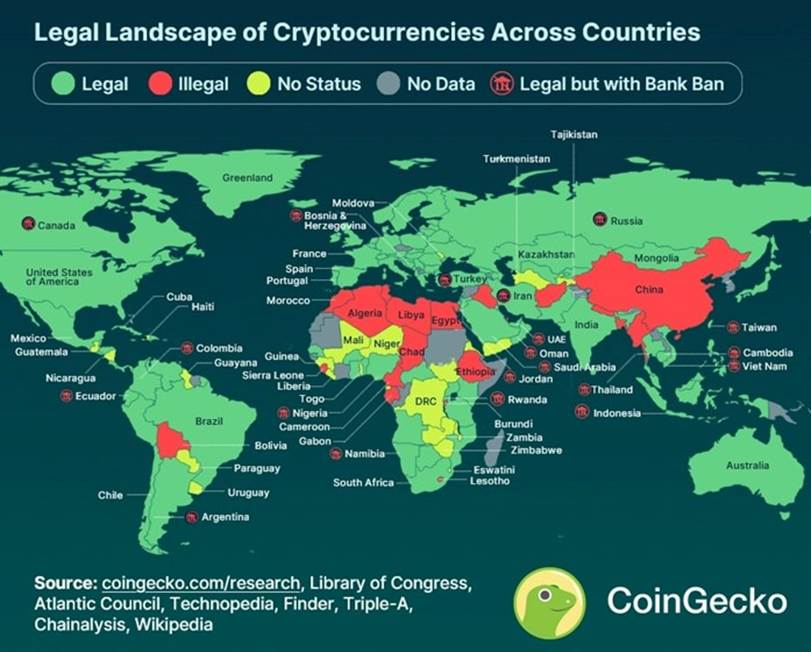
2. Regulatory Clarity: MiCA, GENIUS Act, and Global Standards
Regulation is no longer theoretical; it’s operational:
- EU’s MiCA framework is fully in effect, setting standards for crypto assets and stablecoins.
- U.S. GENIUS Act mandates 100% reserves for stablecoins, bans algorithmic models, and enforces federal registration.
- Asia and the Middle East (Singapore, Hong Kong, UAE) have introduced licensing regimes, positioning themselves as global crypto hubs.
DeFi faces stricter compliance requirements, including governance audits and cross-border risk controls.
Source: CoinGecko
3. Bitcoin and Ethereum: Price Drivers and Outlook
- Bitcoin (BTC): Analysts forecast $140,000-$150,000, with bullish scenarios above $200,000 driven by ETF inflows and post-halving supply constraints.
- Ethereum (ETH): Expected by analysts to trade between $8,000–$15,000, supported by Layer-2 scaling, staking yields, and tokenization growth.
Both assets benefit from ETF-driven liquidity, reducing volatility and reinforcing their role as macro hedges.
4. Stablecoins and CBDCs: Competing for Digital Money
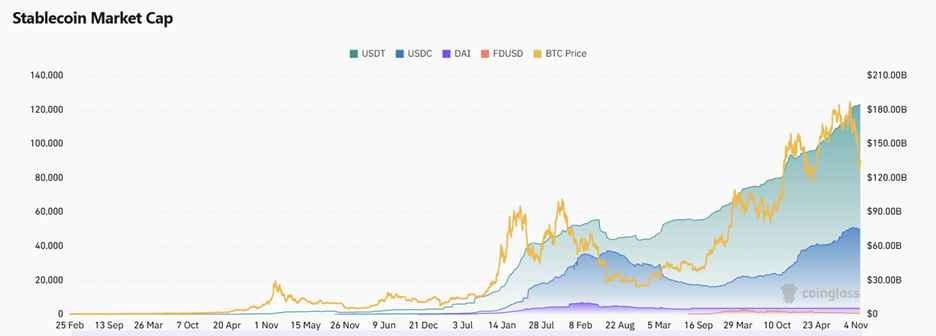
Stablecoins dominate the digital payments narrative:
- Market capitalization exceeds $150 billion, with adoption in cross-border settlement and corporate treasury.
- U.S. and EU regulations enforce strict reserve and audit standards, boosting institutional trust.
CBDCs remain in pilot stages globally, but the U.S. has banned retail CBDCs, favoring regulated private stablecoins under the GENIUS Act.
Source: Coinglass
5. DeFi and Tokenization: Beyond Speculation
DeFi is evolving into a sophisticated financial layer:
- Perpetual DEX volumes hit $1.4 trillion monthly, up 300% YoY.
- Tokenization of real-world assets surged from $13.8B to $36B in 2025, with exponential growth projected for 2026.
- Integration of AI-driven smart contracts and RWA perpetuals is reshaping decentralized finance.
Web3 consolidation accelerates as tech giants acquire DeFi and gaming protocols to integrate blockchain features into mainstream platforms.
6. Risks and Opportunities
Opportunities:
- Institutional inflows projected at $300B in 2026.
- Tokenization and DeFi innovations open new markets for yield and hedging.
Risks:
- Persistent volatility (Bitcoin remains 3–4x more volatile than gold).
- Regulatory fragmentation across jurisdictions.
- Cybersecurity threats and governance vulnerabilities in DeFi.
The Big Picture
2026 is shaping up as crypto’s most transformative year yet—defined by institutionalization, regulatory clarity, and technological innovation. As ARK Invest’s Cathie Wood reiterated, Bitcoin could reach $1.2M by 2030, underscoring its long-term potential as a global store of value.